October 27, 2025 · by Geladas & Bridges
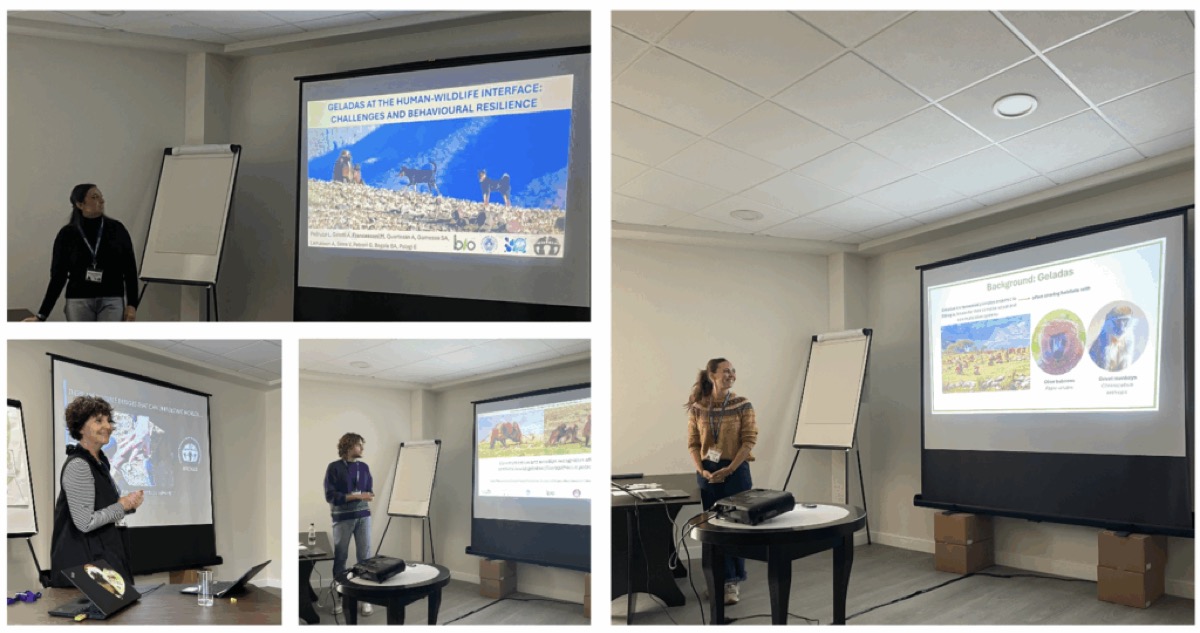
At the beginning of October, our research group had the pleasure of taking part in the 5th International Gelada Workshop, held in Doncaster (UK). The event brought together people who work with geladas at every level, from zoo professionals who manage these fascinating primates in captivity to researchers studying their behaviour, genetics, and ecology. It was a unique opportunity for a full immersion into the world of geladas, fostering collaboration and shared knowledge across institutions and disciplines.
Our team (Elisabetta Palagi, Alice Galotti, Martina Francesconi, and Luca Pedruzzi) contributed to the workshop by presenting the first results of the BRIDGES project. Our work spans both experimental and observational approaches: from playback experiments showing that geladas can recognise social affiliation and emotional cues, to behavioural studies on group dynamics, including play and infant kidnapping. We also explored how these behaviours are shaped by the ecological context, considering the presence of other species (such as olive baboons) and the growing anthropogenic pressures affecting populations living outside protected areas.
Events like this are crucial reminders of how complementary research in captivity and the wild truly is. While captive studies allow us to observe individuals with close focus, providing a solid foundation for hypotheses and experimental designs, field research offers insight into how these behaviours unfold within the complex social and ecological fabric of natural environments.
We are grateful to have been part of such an inspiring meeting, and proud to have shared our scientific contributions, including the first public screening of our documentary film, now available on YouTube. These events remind us how collaboration and communication across the research and zoo communities are essential to both the conservation and the understanding of this remarkable species.